Someone sent me a video this week. A well-known AI researcher had laid out a pattern for organizing knowledge, and my AI system flagged a gap in how mine was structured.
It gave me a clear recommendation: build a raw-source layer, a model borrowed from how document-heavy systems index their sources. I put it in the calendar for Wednesday.
Then I asked my AI system to argue against its own recommendation.
The case did not survive. The gap was real in theory. It never applied to how I actually work. Nothing in two months of logs had ever broken in that direction — the model was borrowed from a document-based system and applied by analogy to a corpus that is mostly my own spoken statements, captured and structured differently. It felt explanatory. It was wrong. I deleted the calendar block.
Whose loop is it
Here is what I keep coming back to.
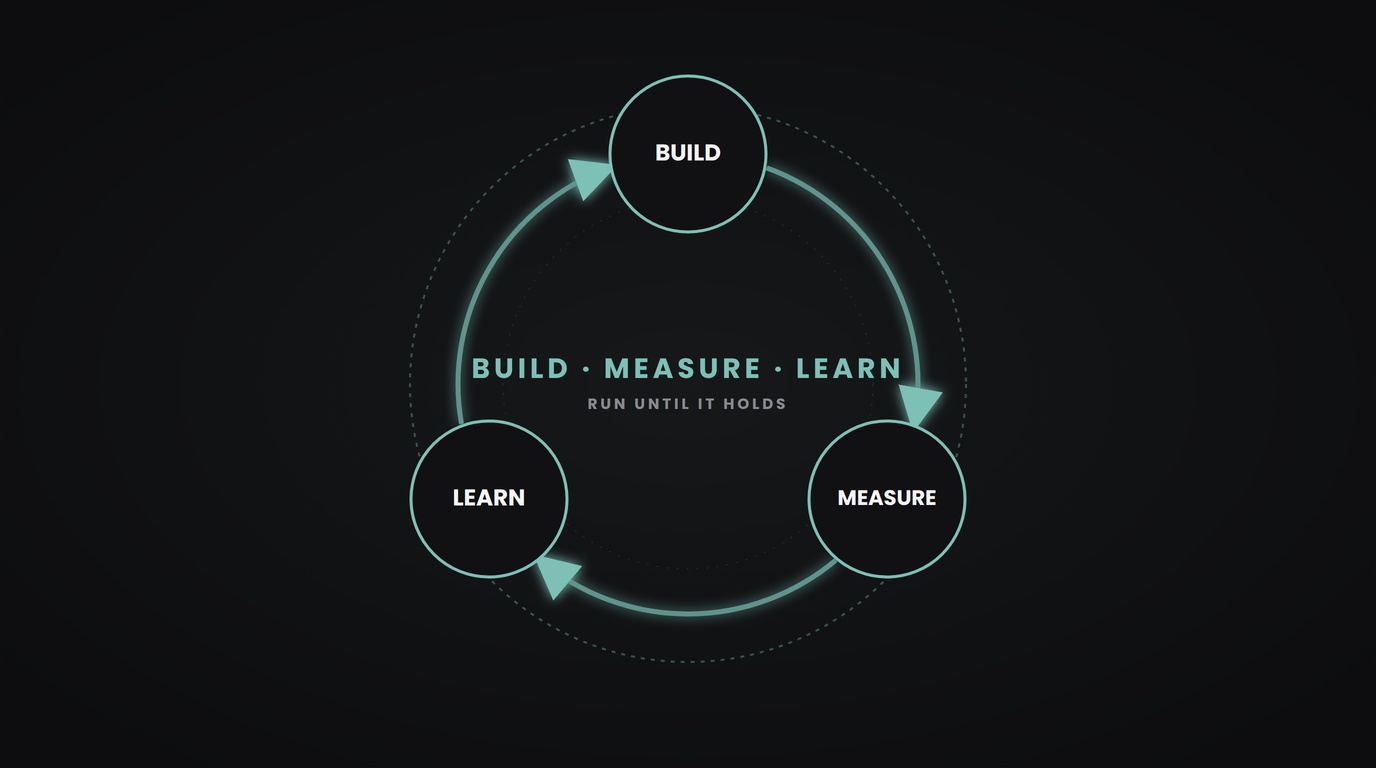
There’s a framework I run on every AI agent I build: build, measure, learn. Build the smallest version. Measure what it actually does against real use. Only then decide what you learned. Eric Ries wrote the book on it, literally — The Lean Startup. The step everyone skips is measure, because it’s the slow one, and because it’s the only one you can’t borrow from someone else.
That’s what nearly got me this week. Someone else had already run their own build-measure-learn loop and posted the result. My system wanted to hand me their “learn” as if it were mine. A researcher tests a pattern, makes a video about it, someone clips the video, a feed serves me the clip. Every one of those steps is a real cycle. None of the cycles are mine.
What doesn’t expire
So I stopped chasing techniques. Techniques go stale in months. I go looking for what doesn’t expire, and I take it wherever I find it — closer to collecting a shelf of big ideas from wherever they come from than tearing a problem down to first principles and rebuilding it from zero. The goal isn’t a clean rebuild. It’s ideas that hold weight from any direction.
The auditor built into my AI system came from natural selection. The routine protocols it runs on me came from human psychology. The way it holds my focus came from goal-setting research that predates the entire field of artificial intelligence by decades. None of that is a technique.
That gives me a half-life to sort against. Tools and prompt patterns: months. Failure modes: years, because they’re a property of the problem, not of whatever is solving it. Judgment about when to trust a recommendation at all: doesn’t decay, and can’t be downloaded from a video — which is exactly what nearly got a calendar block built off someone else’s loop instead of my own.
What doesn’t transfer
Which is also why I don’t read to be instructed anymore. I read for borrowed failure — someone else’s break I don’t have to pay for myself — and I spend maybe five per cent of my attention there, on the long-half-life tier only. The other ninety-five stays on my own build-measure-learn loop with my AI system, run over and over until something holds, because that’s the only place “showing up” actually compounds: not the showing up itself, but the fact that every cycle gets written down, argued with, and kept.
There’s a limitation worth naming here, because it cuts against the tidy version of this story. A system built this way, on this loop, is fitted to exactly one operator. It doesn’t transfer. Someone else inheriting my AI system’s instructions wouldn’t inherit my judgment — they’d inherit a rulebook shaped around eleven years of decisions that aren’t theirs. The loop is the product. The artefact underneath it isn’t, and was never meant to be.
I still nearly built the wrong thing this week. The difference was having something in place whose job is to argue with me before I build, not after.